 Tutoring
  OneCard
  Bookstore
  Library
  Canvas
  Self Service
  Email
Email  Office Apps
  HelpDesk
  Employee Hub
  NetID/Passwords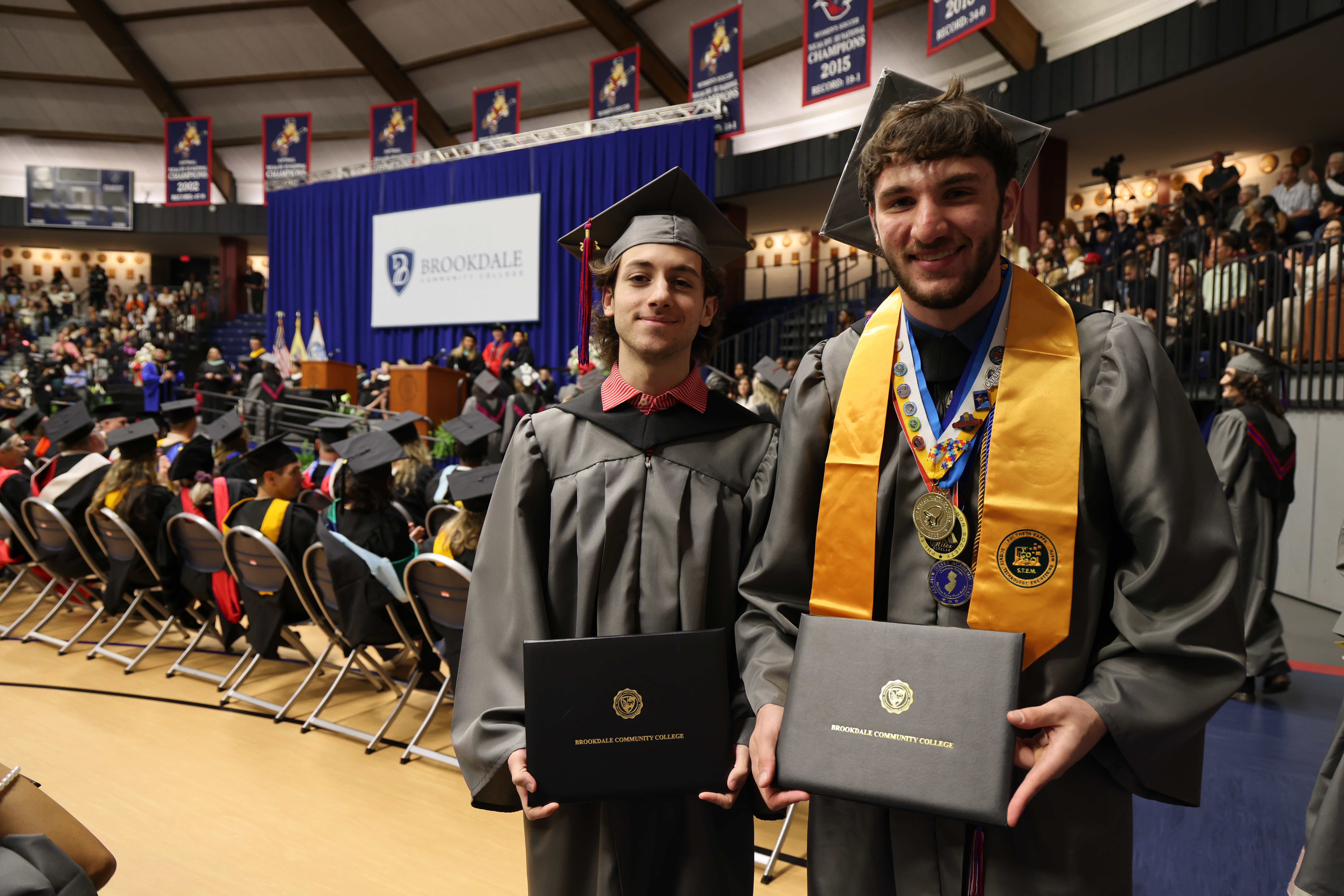
From Brookdale to the Ivy League: New Transfer Pathways Open Doors for Students
Brookdale graduates Adam Deinhardt and Anthony Aldaresi will attend Columbia and Cornell as educators across New Jersey work to expand opportunities for community college students.
 For generations, admission to an Ivy League university was viewed as a destination reserved for students who began their academic journeys at elite preparatory schools or prestigious four-year institutions. Today, that perception is changing.
As community colleges across the nation continue to demonstrate the strength of their students, a growing movement is creating clearer pathways from two-year colleges to some of the most selective universities in the world. At Brookdale Community College, that transformation is already taking shape.
Among the College’s highest-achieving graduates, Adam Deinhardt has been accepted to Columbia University and will continue his education there this fall. He joins fellow graduate Anthony Aldaresi, who will attend Cornell University, marking a significant milestone for Brookdale with two graduates advancing to Ivy League institutions in the same year.
“Brookdale proved to us that we are capable, that we are prepared, and that we can go further than we ever imagined,” Aldaresi told the Class of 2026 during his Commencement address.
Their success reflects a growing national effort to create clearer pathways from community colleges to highly selective universities. That effort was the focus of the inaugural Community College Transfer Pathways Institute hosted by Princeton University, where nearly 90 educators and advisers from 17 community colleges across New Jersey gathered to explore how more students can make the leap from community college to elite four-year institutions.
Creating Pathways to Selective Universities
The conference, led by Princeton University’s Program for Community College Engagement (PCCE) and co-organized with the Office of the Provost, focused on breaking down barriers that have long made selective colleges feel out of reach for many students.
Participants heard a clear message echoed throughout the day: talented community college students not only belong at top-tier universities—they are actively being sought.
“I will tell my students these schools want them on their campuses,” said Victor Stolberg of Essex County College. “There are resources for them. There is a support system for them.”
That message was reinforced by representatives from Lehigh University and Swarthmore College, who joined Princeton officials to demystify the transfer admissions and financial aid process.
“Please encourage your students to look beyond the sticker price,” said Yulia Korovikov of Swarthmore College, noting that financial aid at many selective institutions can cover tuition, housing, and meals.
Princeton, in particular, emphasized its commitment to access.
“We meet 100 percent of demonstrated financial need,” said Courtney Meldrum from the university’s financial aid office, making it one of the most generous aid programs in the country.
A National Push for Transfer Equity
The institute also highlighted broader national efforts to expand access. Leaders shared updates from the American Talent Initiative, which aims to increase enrollment of high-achieving, lower- and moderate-income students at top colleges and universities.
In addition, the Common App introduced its new Community College and Transfer Learner Reach program, designed to better connect transfer students with institutions seeking to enroll them.
Together, these initiatives reflect a growing shift in higher education, one that recognizes community colleges as a critical talent pipeline and transfer students as valuable contributors to campus communities.
The Power of Advising and Mentorship
A key theme throughout the conference was the importance of guidance. Faculty members, advisers, and transfer coordinators, described as “transfer champions” play a vital role in helping students navigate complex application systems, access resources, and build confidence throughout the transfer process.
“Presence matters,” said Kevin Hudson of Princeton University. “It is important that students’ most trusted leaders in community colleges see Princeton and our peer institutions as attainable and affordable.”
Research presented by the Aspen Institute’s College Excellence Program underscored the impact of mentorship, support systems, and strong advising in helping transfer students succeed at highly selective institutions.
From Possibility to Pathway
The institute is part of Princeton University’s broader commitment to expanding educational access. Since reinstating its transfer program in 2018, the university has actively recruited community college students, military veterans, and students from lower-income backgrounds.
Programs such as the Transfer Scholars Institute, offered through Princeton’s Emma Bloomberg Center for Access and Opportunity, provide guidance and support to students considering the transfer pathway.
For educators in attendance, the takeaway was clear: the pathway is real, and it is growing.
“I want students to know these schools are not out of reach for them,” said Nichol Killian of Mercer County Community College. “We have talented students. They do belong at a Princeton, at a Swarthmore, at a Lehigh.”
Expanding Opportunity
As the day concluded, participants shared strategies and ideas to bring back to their campuses, strengthening transfer pipelines and reshaping how students view their futures.
For Brookdale students, the results of those efforts are already visible. With graduates like Adam Deinhardt and Anthony Aldaresi advancing to Columbia and Cornell, the pathway from community college to the nation’s most selective universities is no longer a distant possibility. It is a reality.
What was once considered an unlikely route is becoming a defined and supported journey. One built on talent, determination, mentorship, and opportunity.
For community college students across New Jersey and beyond, the message is simple but powerful: the door to the Ivy League is not closed—it is opening wider than ever.